For more information: DuoSkin
A place where we can dump all the technical information overload and anything else that they need to know.
Showing posts with label Components. Show all posts
Monday, August 15, 2016
DuoSkin | Temporary Tattoo to Control Connected Interfaces
Monday, January 5, 2015
2015 Top 10 Tech Tips for Resolution
We computed your Top 10:
1. Check your backup procedure: Backup solutions are not a “set it and forget it” process. Definitely need to verify the process is still working and that the destinations drive(s) are functioning.
2. Check your anti-virus software program: Make sure it is up to date, that it is scanning regularly. (Microsoft Security Essentials is available to small businesses on up to 10 PCs for free)
3. Tidy the desktop: Clear off old icons, files, and folders.
4. Organize: Keep your computer software all in one place and easily accessible.
5. Insurance: Inventory all your computing hardware.
6. Establish one location: Use one notebook, one folder, whatever it may be, for all your User ID’s, login passwords, email passwords, router settings and anything to do with computing.
7. Change passwords: Time for a better password then yesterday. Help keep the bad guys out of your account by using both your password and your phone. Always sign up for 2-Step verification.
8. Replace power strips: Use a power surge protector. Power strips are great for plugging in lamps, speakers, pencil sharpeners, but not your monitors, routers, backup drives, computers, etc.
9. Replace worn devices: All computing devices fail.
10. Maintenance your computers: Every 3-6 months - clean out temp files, patch it, updated it, stop unwanted startup programs, check the antivirus and backup process.
These 2015 Top 10 tech tips for resolution have been brought to you by tech3Support. Happy shiny new tech year. Best of luck with your other resolutions too.
1. Check your backup procedure: Backup solutions are not a “set it and forget it” process. Definitely need to verify the process is still working and that the destinations drive(s) are functioning.
2. Check your anti-virus software program: Make sure it is up to date, that it is scanning regularly. (Microsoft Security Essentials is available to small businesses on up to 10 PCs for free)
3. Tidy the desktop: Clear off old icons, files, and folders.
4. Organize: Keep your computer software all in one place and easily accessible.
5. Insurance: Inventory all your computing hardware.
6. Establish one location: Use one notebook, one folder, whatever it may be, for all your User ID’s, login passwords, email passwords, router settings and anything to do with computing.
7. Change passwords: Time for a better password then yesterday. Help keep the bad guys out of your account by using both your password and your phone. Always sign up for 2-Step verification.
8. Replace power strips: Use a power surge protector. Power strips are great for plugging in lamps, speakers, pencil sharpeners, but not your monitors, routers, backup drives, computers, etc.
9. Replace worn devices: All computing devices fail.
10. Maintenance your computers: Every 3-6 months - clean out temp files, patch it, updated it, stop unwanted startup programs, check the antivirus and backup process.
These 2015 Top 10 tech tips for resolution have been brought to you by tech3Support. Happy shiny new tech year. Best of luck with your other resolutions too.
Monday, March 3, 2014
Sunday, April 21, 2013
BlabDroids
BlabDroids, (little robot cameras), filming their own documentary, asking questions of whoever decides to pick them up and chat with them:
Friday, February 15, 2013
DisplAir - (Interactive Hologram)
New
technology with limitless applications that will eliminate the need for screens
and monitors.
Thursday, January 24, 2013
A Day Made of Glass 2
Corning’s expanded vision for the future of glass technologies. This video continues the story of how highly engineered glass, with companion technologies, will help shape our world.
Tuesday, January 8, 2013
1TB USB 3.0 Flash Drive
Kingston Digital, Inc., announced the DataTraveler® HyperX® Predator 3.0 USB Flash drive.
DataTraveler HyperX Predator 3.0 is the world's largest-capacity USB 3.0 Flash drive as it will be available in a 1TB capacity later in Q1.
DT HyperX Predator 3.0 is the fastest USB 3.0 Flash drive in the Kingston® family, with speeds of up to 240MB/s read and 160MB/s write. It has also achieved SuperSpeed USB 3.0 certification.
Kingston currently has a 512GB capacity available for shipping.
via Kingston
DataTraveler HyperX Predator 3.0 is the world's largest-capacity USB 3.0 Flash drive as it will be available in a 1TB capacity later in Q1.
DT HyperX Predator 3.0 is the fastest USB 3.0 Flash drive in the Kingston® family, with speeds of up to 240MB/s read and 160MB/s write. It has also achieved SuperSpeed USB 3.0 certification.
Kingston currently has a 512GB capacity available for shipping.
via Kingston
Wednesday, November 28, 2012
Super Computers
The 40th edition of the twice-yearly TOP500 list of the world’s top supercomputers was recently released this month.
Oak Ridge National Laboratory's Titan is a Cray XK7 system
The world’s fastest supercomputer is Titan, a Cray XK7 system installed at Oak Ridge, achieved 17.59 Petaflop/s (quadrillions of calculations per second) on the Linpack benchmark. Titan has 560,640 processors, including 261,632 NVIDIA K20x accelerator cores.
The Sequoia supercomputer built by IBM
Titan knocked Lawrence Livermore National Laboratory’s Sequoia out of No. 1 and into second place. Sequoia, an IBM BlueGene/Q system, was No. 1 in June 2012 with an impressive 16.32 Petaflop/s on the Linpack benchmark. With 1,572,864 cores, Sequoia is the first system with one million or more cores.
Fujitsu’s K computer
Mira, the 10-petaflop IBM Blue Gene/Q
and a BlueGene/Q system named JUQUEEN at the Forschungszentrum Juelich in Germany (No. 5), which was upgraded and is now the most powerful system in Europe.
JUQUEEN at the Forschungszentrum Juelich in Germany
The other new system in the Top 10 is Stampede, a Dell PowerEdge C8220 system installed at the Texas Advanced Computing Center at the University of Texas in Austin. It uses the brand new Intel Xeon Phi processors (previously known as MIC) to achieve its 2.6 Petaflop/s.
In all there are 23 systems with Petaflop/s performance on the latest list, just four-and-a-half years after the debut of Roadrunner, the world’s first Petaflop/s supercomputer. In spite of delivering petascale performance on applications, the Cray Blue Waters system at NCSA at the University of Illinois, Urbana-Champaign, chose not to submit a Linpack benchmark performance figure.
via Top500
Saturday, November 24, 2012
Data Distribution Over 100 Gigabit Networks
During the SuperComputing 2012 (SC12) conference November 12-16, an International team of high energy physicists, computer scientists, and network engineers led by the California Institute of Technology (Caltech), the University of Victoria, and the University of Michigan, together with Brookhaven National Lab, Vanderbilt and other partners, smashed their previous records for data transfers using the latest generation of wide area network circuits.
The international team reached a transfer rate of 339 gigabits per second (Gbps)— equivalent to moving four million gigabytes (or one million full length movies) per day, nearly doubling last year's record.
The team also reached a new record for a two-way transfer on a single link by sending data at 187 Gbps between Victoria, Canada, and Salt Lake City.
via SuperComputing 2012
The international team reached a transfer rate of 339 gigabits per second (Gbps)— equivalent to moving four million gigabytes (or one million full length movies) per day, nearly doubling last year's record.
The team also reached a new record for a two-way transfer on a single link by sending data at 187 Gbps between Victoria, Canada, and Salt Lake City.
Wednesday, October 10, 2012
Digits: A Wrist-Worn Gloveless Sensor
From Oct. 7 to 10 in Cambridge, Mass., Microsoft researchers attending UIST 2012; the 25th Association for Computing Machinery Symposium on User Interface Software and Technology; will be sharing projects and ideas with an international gathering of scientists and practitioners focused on Human-Computer Interaction (HCI).
Microsoft Research’s work in "HCI" helps the company achieve its long-term vision of creating intuitive interfaces that not only revolutionize interactions between humans and computers, but that also empower people from of all walks of life. Digits is one of several research projects presented during UIST 2012 that help further this vision.
via Microsoft Research
Microsoft Research’s work in "HCI" helps the company achieve its long-term vision of creating intuitive interfaces that not only revolutionize interactions between humans and computers, but that also empower people from of all walks of life. Digits is one of several research projects presented during UIST 2012 that help further this vision.
Mobility always has been one of the research team’s goals. To enable ubiquitous 3-D spatial interaction anywhere, Digits had to be lightweight, consume little power, and have the potential to be as small and comfortable as a watch. At the same time, Digits had to deliver superior gesture sensing and “understand” the human hand, from wrist orientation to the angle of each finger joint, so that interaction would not be limited to 3-D points in space. Digits had to understand what the hand is trying to express, even while inside a pocket.
Digits is meant to be a general-purpose interaction platform, and to prove the utility of the technology, both the Digits technical paper being presented during UIST 2012 and an accompanying video present interactive scenarios using Digits in a variety of applications, with particular emphasis on mobile scenarios, where it can interact with mobile phones and tablets.
via Microsoft Research
Tuesday, September 11, 2012
Swarm of 49 Hummingbird Quadrocopters
Ars Electronica Futurelab and Ascending Technologies, featured a world record forty-nine AscTec Hummingbird quadrocopters in a synchronized and choreographed, LED-lit dance. The 500 gram robots were carrying lights and had special radio receivers and slightly modified firmware, but otherwise, they apparently just relied on GPS for positional control.
via ieee spectrum
via ieee spectrum
Tuesday, June 12, 2012
T(ether)
T(ether) is a novel spatially aware display that supports intuitive interaction with volumetric data. The display acts as a window affording users a perspective view of three- dimensional data through tracking of head position and orientation. T(ether) creates a 1:1 mapping between real and virtual coordinate space allowing immersive exploration of the joint domain.
The system creates a shared workspace in which co-located or remote users can collaborate in both the real and virtual worlds. This allows input through capacitive touch on the display and a motion-tracked glove. When placed behind the display, the user’s hand extends into the virtual world, enabling the user to interact with objects directly.
Saturday, March 31, 2012
Intel Ivy Bridge Chips
Your wait is almost over for the next-generation chip, Ivy Bridge. The new chip from Intel promises better battery life and performance improvements.
Ivy Bridge processors should be announced in the 4th week of April, between April 22 and April 28. The announcement will include only quad-core models: mobile Core i7 and Core i7 Extreme families, desktop Core i7, Core i5-3570K, i5-3570T, i5-3550, i5-3550S, i5-3450 and i5-3450S. The announced chips will be available for sale on April 29, and the reviews and benchmarks should be published on the same day.
Dual-core Ivy Bridge Core i3 chips are expected later in the year, in the third quarter--just in time for holiday shopping.
Intel calls Ivy Bridge a tick+. While CPU performance steps forward, GPU performance sees a more significant improvement - in the 20 - 50% range.
Perfect for ultrabooks and smoking fast laptops.
PCWorld
AnandTech
CPU World
Ivy Bridge processors should be announced in the 4th week of April, between April 22 and April 28. The announcement will include only quad-core models: mobile Core i7 and Core i7 Extreme families, desktop Core i7, Core i5-3570K, i5-3570T, i5-3550, i5-3550S, i5-3450 and i5-3450S. The announced chips will be available for sale on April 29, and the reviews and benchmarks should be published on the same day.
Dual-core Ivy Bridge Core i3 chips are expected later in the year, in the third quarter--just in time for holiday shopping.
Intel calls Ivy Bridge a tick+. While CPU performance steps forward, GPU performance sees a more significant improvement - in the 20 - 50% range.
Perfect for ultrabooks and smoking fast laptops.
PCWorld
AnandTech
CPU World
Friday, March 2, 2012
Practical Qubit Computers
Scientists at IBM Research have achieved major advances in quantum computing device performance that may accelerate the realization of a practical, full-scale quantum computer. For specific applications, quantum computing, which exploits the underlying quantum mechanical behavior of matter, has the potential to deliver computational power that is unrivaled by any supercomputer today.
How Quantum Computing Works
The most basic piece of information that a typical computer understands is a bit. Much like a light that can be switched on or off, a bit can have only one of two values: “1″ or “0″. For qubits, they can hold a value of “1” or “0” as well as both values at the same time. Described as superposition, this is what allows quantum computers to perform millions of calculations at once.
One of the great challenges for scientists seeking to harness the power of quantum computing is controlling or removing quantum decoherence – the creation of errors in calculations caused by interference from factors such as heat, electromagnetic radiation, and materials defects. To deal with this problem, scientists have been experimenting for years to discover ways of reducing the number of errors and of lengthening the time periods over which the qubits retain their quantum mechanical properties. When this time is sufficiently long, error correction schemes become effective making it possible to perform long and complex calculations.
IBM has created a high-coherence 3D qubit that retains its state for up to 100 microseconds, or 0.1 milliseconds. This is stable enough that engineers can now shift their focus to scaling up the number of qubits to create a quantum logic computer.
How Quantum Computing Works
The most basic piece of information that a typical computer understands is a bit. Much like a light that can be switched on or off, a bit can have only one of two values: “1″ or “0″. For qubits, they can hold a value of “1” or “0” as well as both values at the same time. Described as superposition, this is what allows quantum computers to perform millions of calculations at once.
One of the great challenges for scientists seeking to harness the power of quantum computing is controlling or removing quantum decoherence – the creation of errors in calculations caused by interference from factors such as heat, electromagnetic radiation, and materials defects. To deal with this problem, scientists have been experimenting for years to discover ways of reducing the number of errors and of lengthening the time periods over which the qubits retain their quantum mechanical properties. When this time is sufficiently long, error correction schemes become effective making it possible to perform long and complex calculations.
IBM has created a high-coherence 3D qubit that retains its state for up to 100 microseconds, or 0.1 milliseconds. This is stable enough that engineers can now shift their focus to scaling up the number of qubits to create a quantum logic computer.
Saturday, February 4, 2012
Sunday, January 22, 2012
Soundmachines
Rather clever device or as they have called it, an instrument for performing electronic music.
Three units, which resemble standard record players, translate concentric visual patterns into control signals for further processing in any music software. The rotation of the discs, each holding three tracks, can be synced to a sequencer.
This is what you get:
Three units, which resemble standard record players, translate concentric visual patterns into control signals for further processing in any music software. The rotation of the discs, each holding three tracks, can be synced to a sequencer.
This is what you get:
Monday, January 2, 2012
Rare Earth Elements – Critical Resource for High Technology
Rare earth elements are used for nuclear batteries, lasers, magnets, portable x-ray machines and aerospace components. But they are also used for your everyday items: laptops, cars, smartphones, TVs, LCD displays, light bulbs, optical networks, and cameras.
China produces over 97% of the world’s rare earth supply and has announced plans to reduce its export quota to 35,000 tons per year in 2010–2015, ostensibly to conserve scarce resources and protect the environment.
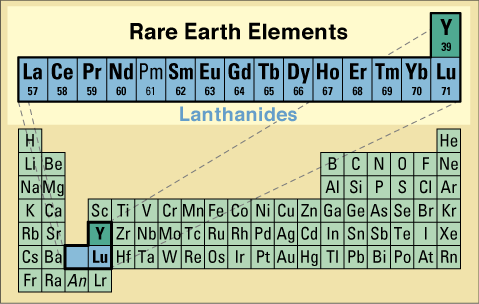
Rare earths — a block of seventeen elements in the middle of the Periodic Table (pictured below) — are not rare, but are very hard to obtain commercially. Generally, rare earth elements are only found in minute quantities in mineral deposits of clay, sand, and rock (earths!), which must then be processed to extract the rare metals — an expensive process, and also costly for the environment as billions of tons of ore must be mined and refined to yield just a few tons of usable rare earths.
Recycling electronic waste is an option to get back the throw-away elements or using technology that does not require these elements, like graphene. The end all, after they have depleted and ravaged China’s supply, is to find another source. We must quench the unsatiable thirst for our gadgets.
The United States Geological Survey is actively surveying southern Afghanistan for rare earth deposits under the protection of United States military forces. Since 2009 the USGS has conducted remote sensing surveys as well as fieldwork to verify Soviet claims that volcanic rocks containing rare earth metals exist in Helmand province near the village of Khanneshin. The USGS study team has located a sizable area of rocks in the center of an extinct volcano containing light rare earth elements including cerium and neodymium. It has mapped 1.3 million metric tons of desirable rock, or about 10 years of supply at current demand levels. The Pentagon has estimated its value at about $7.4 billion.
Rare earth elements are not exchange-traded in the same way that precious (for instance, gold and silver) or non-ferrous metals (such as nickel, tin, copper, and aluminum) are. Instead they are sold on the private market, which makes their prices difficult to monitor and track.
Read more: Wiki, Rare Elements via U.S. Geological Survey, ExtremeTech
China produces over 97% of the world’s rare earth supply and has announced plans to reduce its export quota to 35,000 tons per year in 2010–2015, ostensibly to conserve scarce resources and protect the environment.
Rare earths — a block of seventeen elements in the middle of the Periodic Table (pictured below) — are not rare, but are very hard to obtain commercially. Generally, rare earth elements are only found in minute quantities in mineral deposits of clay, sand, and rock (earths!), which must then be processed to extract the rare metals — an expensive process, and also costly for the environment as billions of tons of ore must be mined and refined to yield just a few tons of usable rare earths.
Recycling electronic waste is an option to get back the throw-away elements or using technology that does not require these elements, like graphene. The end all, after they have depleted and ravaged China’s supply, is to find another source. We must quench the unsatiable thirst for our gadgets.
The United States Geological Survey is actively surveying southern Afghanistan for rare earth deposits under the protection of United States military forces. Since 2009 the USGS has conducted remote sensing surveys as well as fieldwork to verify Soviet claims that volcanic rocks containing rare earth metals exist in Helmand province near the village of Khanneshin. The USGS study team has located a sizable area of rocks in the center of an extinct volcano containing light rare earth elements including cerium and neodymium. It has mapped 1.3 million metric tons of desirable rock, or about 10 years of supply at current demand levels. The Pentagon has estimated its value at about $7.4 billion.
Rare earth elements are not exchange-traded in the same way that precious (for instance, gold and silver) or non-ferrous metals (such as nickel, tin, copper, and aluminum) are. Instead they are sold on the private market, which makes their prices difficult to monitor and track.
Read more: Wiki, Rare Elements via U.S. Geological Survey, ExtremeTech
Subscribe to:
Posts (Atom)