Showing posts with label Computing. Show all posts

Wednesday, December 20, 2017

10 Breakthrough Technologies

MIT Technology Review presents these 10 breakthrough technologies. They will affect the economy and our politics, improve medicine, or influence our culture. Some are unfolding now; others will take a decade or more to develop.


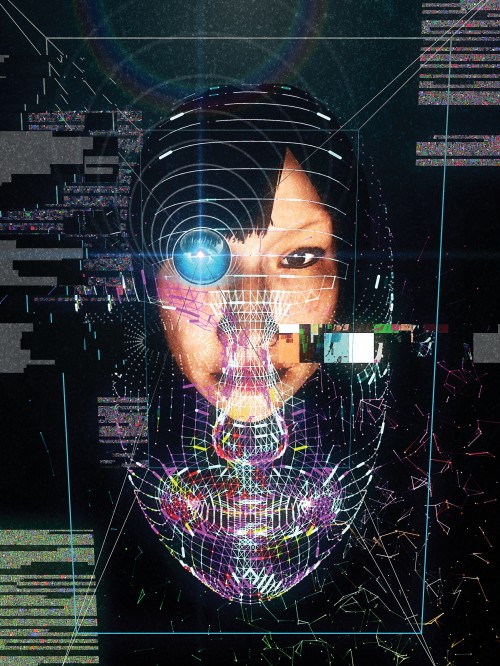
One of those technologies is PAYING WITH YOUR FACE, which you can do now. Face-detecting systems in China now authorize payments, provide access to facilities, and track down criminals. Will other countries follow?


Monday, August 15, 2016

DuoSkin | Temporary Tattoo to Control Connected Interfaces


Microsoft Research and MIT Media Lab recently introduced a new product called DuoSkin. DuoSkin is basically a temporary tattoo that will allow you to control connected interfaces. For example, you can use it to control a game or even your smartphone. Additionally, you can use DuoSkin as an NFC tag, which you can easily use with your smartphone.


For more information: DuoSkin

Friday, June 5, 2015

Two-Factor Authentication

Two-factor authentication adds an extra layer of security by asking you to provide two forms of identification before you can access your personal information. The first is your usual user ID and password. The second is typically a unique code that is sent to your phone or some other physical device, that you then enter during the second stage of the login process.

Because the second identifier is sent to something that you physically carry with you, it makes it harder for hackers to access your information.

Apple: Apple sends a four-digit code via SMS or Find My iPhone to register your machine as a trusted device. Anytime you try to access your iCloud or iTunes account from a new device, you’ll be required to enter a new four-digit passcode. Instructions on how to enable two-step verification for your Apple ID are here.
Google: Google can send verification codes in several different ways: SMS, voice call, or through its Google Authenticator app. During initial sign-in, you can tell Google to remember your device for 30 days. But a new code is required anytime someone tries to log in from a new machine.
Yahoo Mail: Once two-step authentication is activated, Yahoo will send a passcode via text or voice call. The verification process will only occur whenever you’re logging in from a new computer or mobile device, or if you’ve cleared your browser’s cache.
Facebook: Facebook offers login approvals, which require you to enter a passcode anytime you try to log in from an unrecognized computer or mobile phone. Codes are sent via text message.
Twitter: Twitter will send a verification code via text or as a push notification on iOS and Android devices. The company also provides a backup code, so that in the event that you lose your phone, you can enter the backup code to log in to your account. This isn’t saved anywhere, so be sure to write it down someplace.
Dropbox: Like the others, you’ll receive a code anytime you try to access Dropbox from a new machine. They can be sent via text, or you can use an app like Google Authenticator or Duo Mobile. The company also provides a 16-digit backup code in case you lose your phone or for some reason can’t receive a PIN using the aforementioned methods. Again, write it down somewhere safe.
OneDrive: You can receive codes from Microsoft via text, email or authenticator app. A PIN is only required when you sign in from an untrusted device. Instructions on how to enable two-step verification are available here.

Tuesday, September 3, 2013

Wearable Authentication Device | Utilizes Your Electrocardiogram (ECG)

Bionym has developed the first wearable authentication device that utilizes a user's Electrocardiogram (ECG) to validate a person’s identity. The Nymi has two electrodes, one on the wrist and one on the top. To authenticate, a user must attach the Nymi, and then place their finger on the top electrode to complete the electric current. A user only needs to validate their identity once, until the Nymi is removed. The closed loop keeps the Nymi in an authenticated state, removing all need for repeated prompts (such as in fingerprint scanning or PIN requests).


Once authenticated, the Nymi communicates the user’s identity to a device (such as a smartphone, vehicle, elctronic lock, or even a smart environtment) using Bluetooth Low Energy (BLE). The Nymi not only uses the BLE to reliably communicate with the world, but it also uses it to sense how far away it is from devices (proximity detection). The Nymi allows users to interact with the world as a person, not as a number.

via Bionym

Monday, May 27, 2013

X-47B: Unmanned Combat Air System


The X-47B is an unmanned combat air system carrier (UCAS) being developed by Northrop Grumman for the US Navy (USN). The strike fighter size unmanned aircraft is currently in its demonstration phase. The unmanned aircraft was first developed as part of the X-47 program.
Air worthiness of the X-47B unmanned combat air system demonstrator was developed at an estimated cost of $813m. The aircraft performed a successful initial test flight at Patuxent River, Maryland, in July 2012. The X-47B is expected to enter active naval service by 2019.
The video below demonstrates the first time any unmanned aircraft has completed a touch and go landing at sea.
An X-47B Unmanned Combat Air System (UCAS) demonstrator conducts a touch and go landing on the flight deck of the aircraft carrier USS George H.W. Bush (CVN 77)

Thursday, May 2, 2013

A Boy and His Atom


IBM has released the world’s smallest movie. Company researchers moved thousands of atoms to create a miniature stop-motion movie titled A Boy and His Atom.
IBMmovieA Scene From A Boy and His Atom by IBM Research
The movie, which has 242 frames, was made with a scanning tunneling microscope (STM) which IBM Research has been using to conduct research into data storage. The movie has been certified as the world’s smallest by the Guinness World Records, according to IBM.
The film shows that it’s possible to manipulate single atoms and molecules with the tip of an STM, and IBM scientists had to develop “new low temperature, ultra-stable scanning tunneling microscopic techniques” over many years,” Crommie told TechNewsWorld.

Tuesday, February 26, 2013

MYO - Armband Gesture Control

The MYO armband lets you use the electrical activity in your muscles to wirelessly control your computer, phone, and other favorite digital technologies.

Using groundbreaking technology, MYO is able to measure electrical activity in your muscles instantly. The result is a seamless way to interact with computers, and a truly magical sense of control. Pre-order for $149.


Friday, February 15, 2013

DisplAir - (Interactive Hologram)

New technology with limitless applications that will eliminate the need for screens and monitors.


Sunday, February 10, 2013

IBM Watson Healthcare

IBM has taken a major step forward with partners Memorial Sloan Kettering and WellPoint in putting IBM Watson to work in healthcare.

On Friday, February 8th, the team unveiled the first commercially-developed Watson-based breakthroughs. These innovations have the potential to help transform the quality and speed of care — and the entire healthcare industry — through individualized evidence-based medicine.


via IBM Watson

Wednesday, November 28, 2012

Super Computers

The 40th edition of the twice-yearly TOP500 list of the world’s top supercomputers was recently released this month. 

 Oak Ridge National Laboratory's Titan is a Cray XK7 system

The world’s fastest supercomputer is Titan, a Cray XK7 system installed at Oak Ridge, achieved 17.59 Petaflop/s (quadrillions of calculations per second) on the Linpack benchmark. Titan has 560,640 processors, including 261,632 NVIDIA K20x accelerator cores.

The Sequoia supercomputer built by IBM 

Titan knocked Lawrence Livermore National Laboratory’s Sequoia out of No. 1 and into second place. Sequoia, an IBM BlueGene/Q system, was No. 1 in June 2012 with an impressive 16.32 Petaflop/s on the Linpack benchmark. With 1,572,864 cores, Sequoia is the first system with one million or more cores.

 Fujitsu’s K computer

Rounding out the top five systems are Fujitsu’s K computer installed at the RIKEN Advanced Institute for Computational Science (AICS) in Kobe, Japan (No. 3); a BlueGene/Q system named Mira at Argonne National Laboratory (No. 4);

Mira, the 10-petaflop IBM Blue Gene/Q 

and a BlueGene/Q system named JUQUEEN at the Forschungszentrum Juelich in Germany (No. 5), which was upgraded and is now the most powerful system in Europe.

JUQUEEN at the Forschungszentrum Juelich in Germany

The other new system in the Top 10 is Stampede, a Dell PowerEdge C8220 system installed at the Texas Advanced Computing Center at the University of Texas in Austin. It uses the brand new Intel Xeon Phi processors (previously known as MIC) to achieve its 2.6 Petaflop/s.

In all there are 23 systems with Petaflop/s performance on the latest list, just four-and-a-half years after the debut of Roadrunner, the world’s first Petaflop/s supercomputer. In spite of delivering petascale performance on applications, the Cray Blue Waters system at NCSA at the University of Illinois, Urbana-Champaign, chose not to submit a Linpack benchmark performance figure.

via Top500
Saturday, November 24, 2012

Data Distribution Over 100 Gigabit Networks

During the SuperComputing 2012 (SC12) conference November 12-16, an International team of high energy physicists, computer scientists, and network engineers led by the California Institute of Technology (Caltech), the University of Victoria, and the University of Michigan, together with Brookhaven National Lab, Vanderbilt and other partners, smashed their previous records for data transfers using the latest generation of wide area network circuits. 

The international team reached a transfer rate of 339 gigabits per second (Gbps)— equivalent to moving four million gigabytes (or one million full length movies) per day, nearly doubling last year's record.

The team also reached a new record for a two-way transfer on a single link by sending data at 187 Gbps between Victoria, Canada, and Salt Lake City.


via SuperComputing 2012

Wednesday, October 10, 2012

Digits: A Wrist-Worn Gloveless Sensor

From Oct. 7 to 10 in Cambridge, Mass., Microsoft researchers attending UIST 2012; the 25th Association for Computing Machinery Symposium on User Interface Software and Technology; will be sharing projects and ideas with an international gathering of scientists and practitioners focused on Human-Computer Interaction (HCI).

Microsoft Research’s work in "HCI" helps the company achieve its long-term vision of creating intuitive interfaces that not only revolutionize interactions between humans and computers, but that also empower people from of all walks of life. Digits is one of several research projects presented during UIST 2012 that help further this vision.


Mobility always has been one of the research team’s goals. To enable ubiquitous 3-D spatial interaction anywhere, Digits had to be lightweight, consume little power, and have the potential to be as small and comfortable as a watch. At the same time, Digits had to deliver superior gesture sensing and “understand” the human hand, from wrist orientation to the angle of each finger joint, so that interaction would not be limited to 3-D points in space. Digits had to understand what the hand is trying to express, even while inside a pocket.

Digits is meant to be a general-purpose interaction platform, and to prove the utility of the technology, both the Digits technical paper being presented during UIST 2012 and an accompanying video present interactive scenarios using Digits in a variety of applications, with particular emphasis on mobile scenarios, where it can interact with mobile phones and tablets.


via Microsoft Research

Saturday, October 6, 2012

Server Sky | Orbiting Data Centers

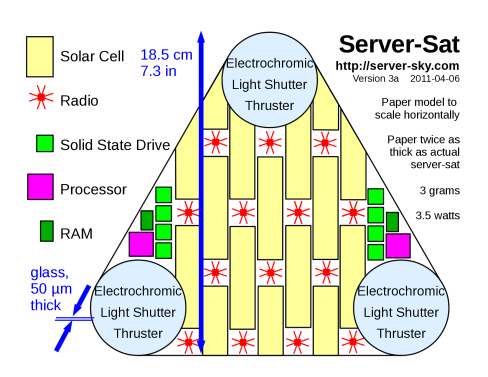
Traditional data centers consume almost 3% of US electrical power, and this fraction is growing rapidly. Server arrays in orbit can grow to virtually unlimited computation power, communicate with the whole world, pay for themselves with electricity savings, and greatly reduce pollution and resource usage in the biosphere.

Keith Lofstrom is an electrical engineer who believes that he may have found a long term solution to the data center problem. Lofstrom wants to put huge number of miniature, solar powered servers (called thinsats) in orbit. This concept, known as "server sky", would be facilitated by a low-cost launch system referred to as "Launch Loop". This loop could put many thousands of tons into space at a small fraction of the cost of using rockets.

Server Sky thinsats are ultralight films of glass that convert sunlight into computation and communications. Powered by solar cells, propelled and steered by light pressure, networked and located by microwaves, and cooled by radiation into deep space. Arrays of tens of thousands of thinsats act as highly redundant computation and database servers, as well as phased array antennas to reach thousands of transceivers on the ground.

Server Sky is speculative. The most likely technical showstopper is 
radiation damage. The most likely practical showstopper is misunderstanding. 


Thursday, September 20, 2012

"First Retail 3-D printing store" in the U.S.

MakerBot, the unofficial leader of the hobbyist 3-D printing movement, has opened a consumer store located in the posh Manhattan neighborhood of NoHo.


The first full MakerBot retail experience in the world, will give customers the unprecedented opportunity to experience the MakerBot Replicator 2 Desktop 3D Printer, live and in-person. Stop in to watch MakerBots at work, learn about 3D design and 3D printing, and leave with an authentic MakerBot-made gift for you or someone you think is cool enough to have it.

via POPSCI

Tuesday, September 11, 2012

Swarm of 49 Hummingbird Quadrocopters

Ars Electronica Futurelab and Ascending Technologies, featured a world record forty-nine AscTec Hummingbird quadrocopters in a synchronized and choreographed, LED-lit dance. The 500 gram robots were carrying lights and had special radio receivers and slightly modified firmware, but otherwise, they apparently just relied on GPS for positional control.


via ieee spectrum

Tuesday, June 12, 2012

T(ether)


T(ether) is a novel spatially aware display that supports intuitive interaction with volumetric data. The display acts as a window affording users a perspective view of three- dimensional data through tracking of head position and orientation. T(ether) creates a 1:1 mapping between real and virtual coordinate space allowing immersive exploration of the joint domain.
The system creates a shared workspace in which co-located or remote users can collaborate in both the real and virtual worlds. This allows input through capacitive touch on the display and a motion-tracked glove. When placed behind the display, the user’s hand extends into the virtual world, enabling the user to interact with objects directly.

Friday, March 2, 2012

Practical Qubit Computers

Scientists at IBM Research have achieved major advances in quantum computing device performance that may accelerate the realization of a practical, full-scale quantum computer. For specific applications, quantum computing, which exploits the underlying quantum mechanical behavior of matter, has the potential to deliver computational power that is unrivaled by any supercomputer today.

How Quantum Computing Works

The most basic piece of information that a typical computer understands is a bit. Much like a light that can be switched on or off, a bit can have only one of two values: “1″ or “0″. For qubits, they can hold a value of “1” or “0” as well as both values at the same time. Described as superposition, this is what allows quantum computers to perform millions of calculations at once.

One of the great challenges for scientists seeking to harness the power of quantum computing is controlling or removing quantum decoherence – the creation of errors in calculations caused by interference from factors such as heat, electromagnetic radiation, and materials defects. To deal with this problem, scientists have been experimenting for years to discover ways of reducing the number of errors and of lengthening the time periods over which the qubits retain their quantum mechanical properties. When this time is sufficiently long, error correction schemes become effective making it possible to perform long and complex calculations.

IBM has created a high-coherence 3D qubit that retains its state for up to 100 microseconds, or 0.1 milliseconds. This is stable enough that engineers can now shift their focus to scaling up the number of qubits to create a quantum logic computer.

Sunday, February 12, 2012

Monday, December 5, 2011

Flexible 3D AMOLED Display

Samsung Mobile Display produced a short video (in Korean) showing a transparent, flexible 3D AMOLED display based tablet. This is just a concept device, and it should take years before commercialization of the product.

We will be waiting to service it: